
Start a structured citation during the enforcement contact.
Citation Platform by LevelReach
A connected citation workflow built around the people who use it.
From roadside entry to agency review and court administration, Citation Platform is designed to keep the process clear, accountable, and practical to deploy.
Connected workflow
Each handoff supports the next.
The platform connects responsibilities without treating every user, task, or device the same.
Keep required information and review steps clear on the MDT.
Use Companion Mobile for close-range review and signature support.
Give authorized staff history, settings, reporting, and correction tools.
Support clerk review, dates, and the next administrative step.
The working interface
Built for patrol conditions, not a generic office form.
Citation Platform keeps the most important actions obvious, separates dense information into manageable sections, and gives each role a workspace designed for its part of the process.
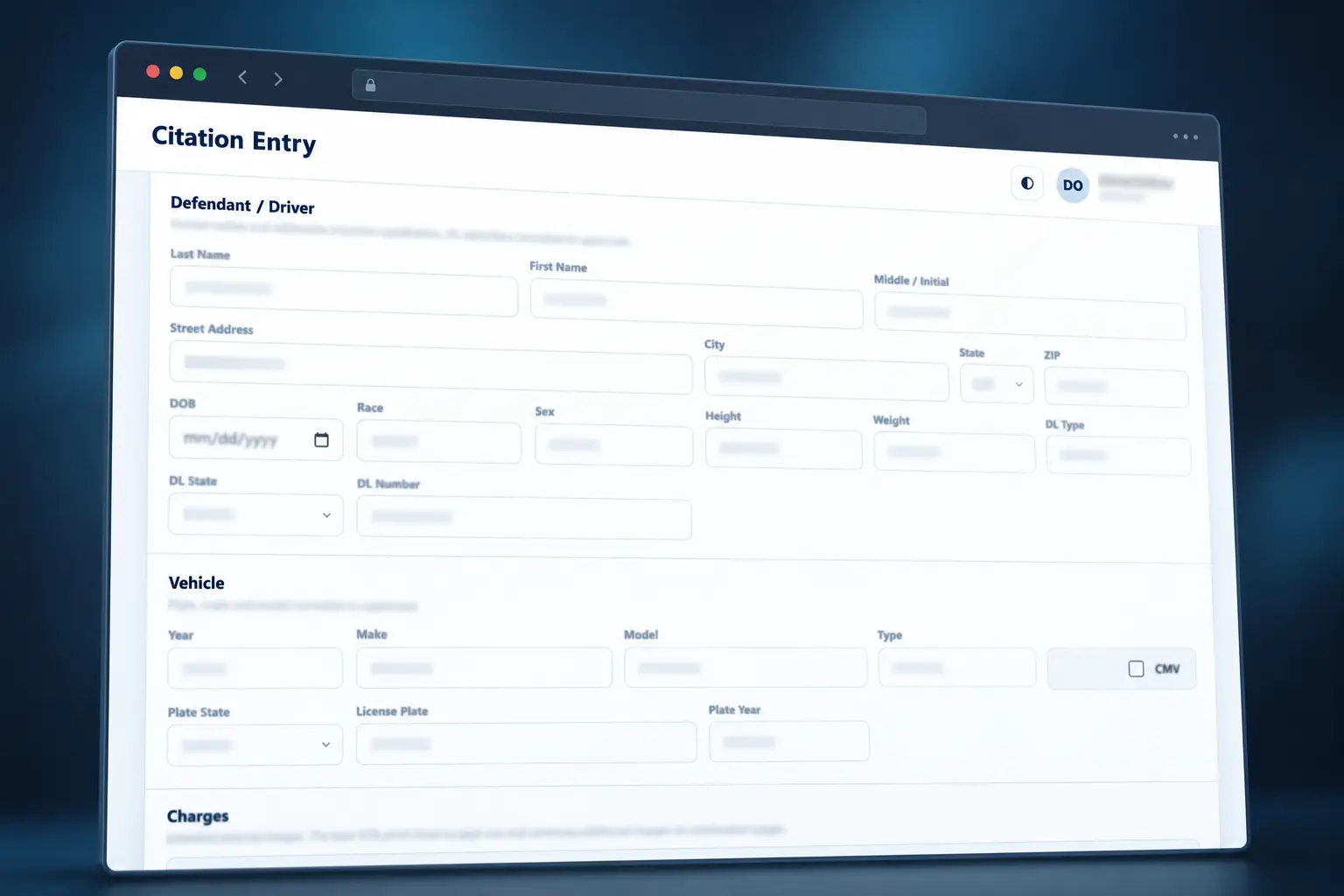
 Protected LevelReach product preview
The next action is easy to spot.
Start a new citation, resume an open draft, check court information, review printing activity, and return to recent work from one starting point.
Complex entry stays organized.
Defendant or driver, vehicle, charges, court information, review, signature, and issuance are separated into clear parts of the same citation.
The interface adapts to the person and environment.
Multiple light, dark, color, paper, and high-contrast themes support daylight, nighttime, and accessibility needs without changing the workflow.
This image is derived from a working pre-release interface. Names, values, and implementation details are obscured, and the design may change before release.
Officer experience
Focused on completing the citation, not navigating the software.
The field experience is organized around the citation itself. Structured sections help the officer move through person, vehicle, location, violation, court, review, signature, and issue with fewer chances to lose context.
Structured entryClear sections, required fields, and review cues.
Practical lookupsSupport information entry without crowding the workflow.
Review before issueMake the final check understandable before completion.
Print and recordKeep the roadside and agency steps connected.

Designed for the vehicle environmentA focused experience for the computer already used in patrol work.

Companion MobileClose-range field steps without moving the entire MDT workflow to a phone.
Companion Mobile
Bring the right part of the workflow to the driver.
A companion device can support signature and field interaction while the main citation remains tied to the officer’s larger workspace. The goal is not another disconnected app. It is a focused extension of the same responsible process.
- Review information intended for field confirmation
- Support signature capture and close-range interaction
- Return the completed step to the officer workflow
- Keep access aligned with the active session and role
Images show representative use. Final device support and agency configuration are confirmed during evaluation.
Agency administration
Useful control without an enterprise-sized burden.
Authorized agency staff need to understand what is happening across users, citations, settings, and security without relying on one person to know every technical detail.
Review SecurityUser and role management
Align access with officer, supervisor, administrator, clerk, auditor, and platform responsibilities.
Citation history and status
Find issued work, understand its current state, and review meaningful activity.
Controlled amendments
Support authorized corrections while preserving versions and accountability.
Agency configuration
Manage appropriate settings, court relationships, and operational expectations.
Reporting and oversight
Give authorized leaders useful operational visibility without exposing every control.
Court workflow
Give clerks accurate information and a clear next step.
Citation information should arrive in a form that supports review and administration. Court-focused access helps separate clerk responsibilities from agency administration while keeping the handoff understandable.
- Organized citation review
- Court date and administrative workflow
- Role-appropriate access to citation records
- History for authorized changes and activity
- A clearer line back to agency workflow when attention is needed

A practical evaluation
Explore the questions that matter before deployment.
A credible fit includes the workflow, the people, the devices, the court relationship, and the security responsibilities around them.
What should officers evaluate?
How citation entry fits the patrol vehicle, which steps require attention, how review and correction work, and how signature and printing fit the contact.
What should agency administrators evaluate?
User roles, lifecycle controls, settings, citation history, amendments, reporting, training expectations, and the work required to operate the system responsibly.
What should court staff evaluate?
How citations arrive, what information is available for review, how dates and changes are handled, and where agency and court responsibilities meet.
What belongs in a security review?
Identity, MFA, roles, sessions, devices, protected data, auditability, recovery, incident communication, shared responsibilities, and any controlled technical documentation appropriate to the stage of evaluation.
Clear claims matter.
Citation Platform is designed with CJIS-oriented security principles. LevelReach does not claim CJIS certification, KHP approval, government endorsement, or formal agency approval.
Bring your current process